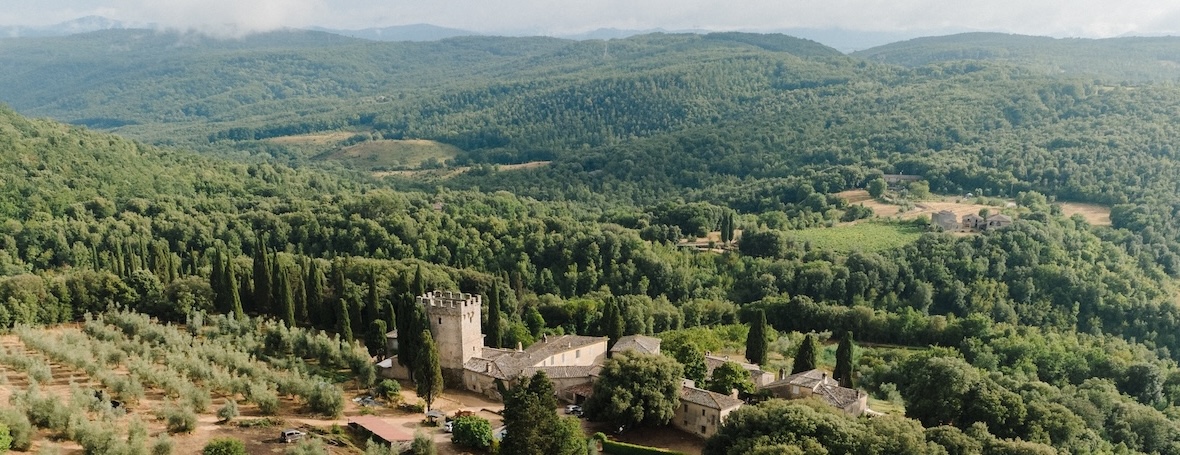
As we prepared to write about our November 2025 theme—environmentalism and conservation—we read through some interesting pieces about Spannocchia from past newsletters. Randall Stratton’s intro to our Spring 2014 newsletter was particularly relevant, so we share his own words with you again now:
“As part of the Tuscan Regional Nature Reserve Alto Merse, we help to preserve the natural environment. The traditional landscape typical of the mezzadria tenant farming system that characterized Spannocchia and rural Tuscany for centuries, could have easily been lost if we had done what most similar properties did following the Second World War. Many were broken into multiple residential properties and farming ceased entirely; some became vacation resorts; others continued to farm, but with new methods of monoculture: converted to all vineyards, olive groves, or grain fields. If Spannocchia were an exclusively for-profit farming enterprise, we would find it hard to justify the variety of small-scale agricultural activities we pursue: vegetable gardening, grape growing and wine making, olives for oil, cereal crops, fruit and nut trees, animal raising and meat processing, harvesting firewood. But our main goal is not so much profit as conservation, and the continuation of all these activities is key to preserving that traditional landscape of a centuries old way of life that no longer exists. That is one reason Spannocchia is not just a farm today, but also a non-profit educational center, and why we value contributions which help us to pursue activities that a strictly for-profit could not afford. When I arrived at Spannocchia for the first time, in 1981, the property was already becoming an unusual example of a still relatively intact traditional Tuscan tenuta, or farm estate. Initially our main conservation efforts consisted of simply trying to change the place as little as possible, preserving what was still there. Over the years, however, our conservation-related activities have grown to encompass a diverse range, thematically and practically central to what Spannocchia is today.”
Reflecting on Spannocchia in 2025, both while reading Randall’s words from 11 years ago and as we have celebrated the property and our work throughout the last ten months, it’s striking how much the philosophy he captures has not changed, even as some of the specific practices have. Throughout the last three decades, we’ve raised sheep, horses, and donkeys—none of which remain part of Spannocchia’s operation now. We stopped growing cereal crops, after years of having production thwarted by hungry deer and wild boar. But we’ve also expanded and improved: we moved the main vegetable garden from the cramped and hard-to-access terraces near the Villa to the large field down the driveway at Capannone, and Chiara transformed the Villa garden space into a mixed ornamental and herb garden filled with native and drought-resistant plants. And, with donor support, Friends of Spannocchia has worked with the farm to execute three significant projects over just the last three years:
- We’ve transitioned the vegetable gardens from sustainable and organic practices to no-till regenerative agriculture—improving soil health, sequestering more carbon, increasing organic matter and water retention, and expanding biodiversity.
- We’ve improved the wastewater system, introducing a solar pump, oxygenator, water storage and irrigation system, and ducks—conserving and recycling excess water in the wastewater pond to irrigate the nearby orchard.
- We’ve raised money and are preparing (this winter) to plant a new vineyard—increasing regenerative land stewardship in this area of the property, expanding agro-forestry practices, and modeling how to create natural wine in a way that respects and honors the environment.
These are just a few examples of how environmentalism and conservation play a key role in all of our work and decision-making, and how we then highlight these principles as we educate interns, apprentices, program participants, and guests about each of the projects.
Another, perhaps less obvious way Spannocchia embraces conservation is through our approach to maintaining and restoring the human-made elements of the property. Again, from the 2014 newsletter, is an explanation that still rings true today:
“Since the buildings of Spannocchia have been integral to its landscape since the 12th century, it is only natural that we place great importance on architectural conservation on the estate. Today both specific projects and routine maintenance reflect our concerns with conserving the past, and also with conserving natural resources. Visitors are sometimes surprised, considering the well-worn and aged appearance of our buildings, that virtually all of them have undergone major renovations: new roofs, entire new electrical and plumbing systems (tied in to our all natural wastewater treatment system for the Castello), a total of 32 new or renewed bathrooms [2025 update: this number is now over 40!]. We have incorporated innovations like insulation and water saving fixtures, but always with traditional materials and classic style.
Ongoing maintenance is also guided by conservation concerns. A new paved driveway would require virtually no maintenance, but aside from introducing a modern, foreign, and not very attractive material into our landscape, it would represent certain environmental disadvantages. Our traditional gravel drive, maintained with local crushed stone, being naturally permeable reduces water runoff during rain storms, and adds only indigenous material to the local ecosystem. The constant work of filling potholes, grading, and maintaining drainage ditches is worth it to sustain the historic and aesthetic character of our landscape. Maintenance of our many kilometers of fieldstone walls is also an ongoing task. Most of these walls, many of them centuries old, are dry stone built without any mortar. Most were constructed as part of the terracing of agricultural land, to provide level growing spaces on hilly slopes. Dry stone provides good drainage of the terrace above, an important characteristic for growing healthy vines and olives. Every year a section on one or more of these walls finally gives in to gravity and water pressure, and tumbles into a pile of loose stones. We eventually put them back together again, in one more way maintaining that iconic Tuscan landscape, and keeping our vines and olive trees happy.”
As this big anniversary year comes to an end and we look to the future, we remember Randall’s own words and honor the dedication and expertise of our current staff, allowing the principles of environmentalism and conservation to continue to guide us in our work ahead.